Strapline: Enjoy stable, long-term savings now with Hayleys Solar
Ayanthi Udugampola
Pictures by Sudath Malaweera
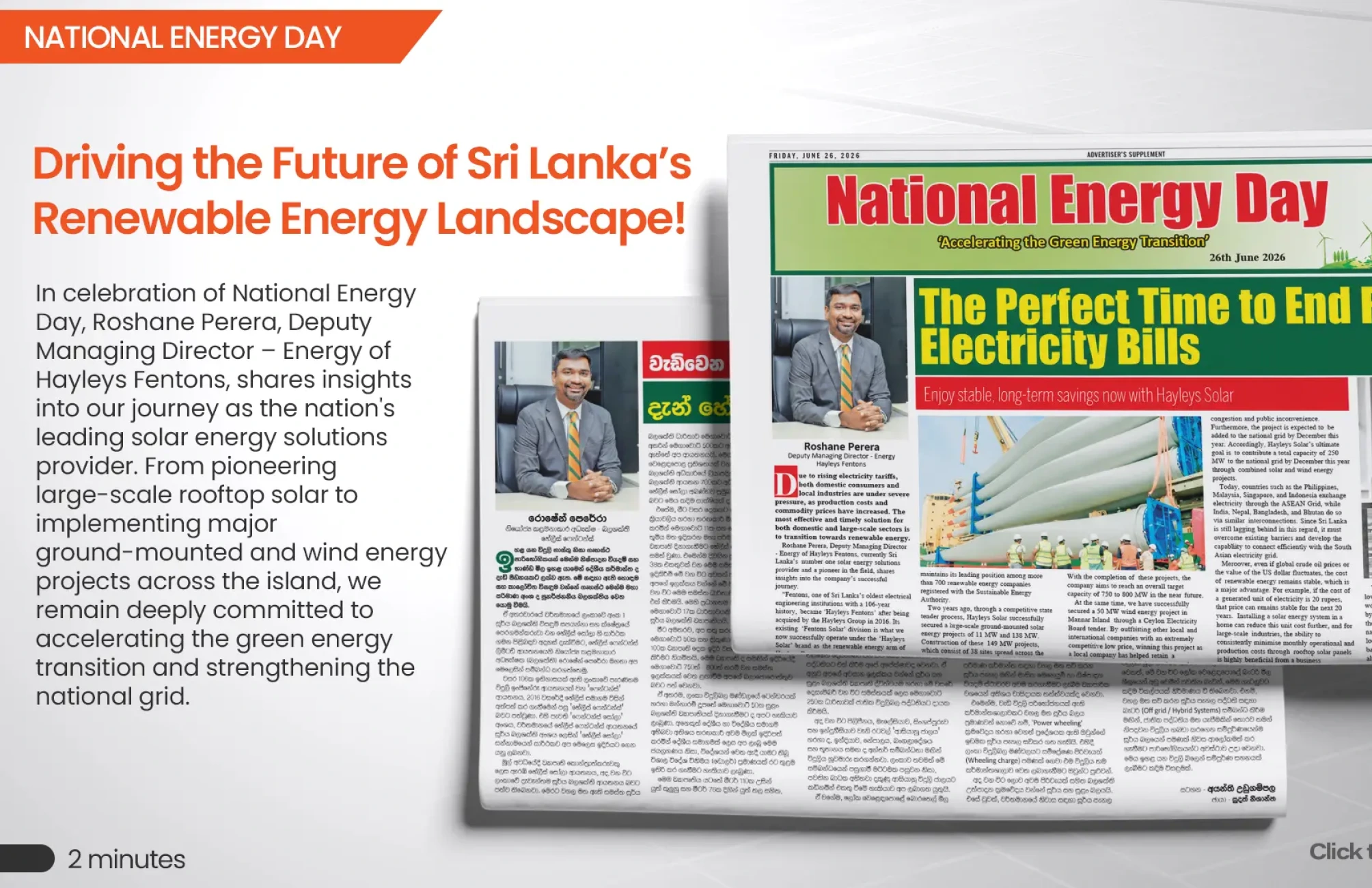
Due to rising electricity tariffs, both domestic consumers and local industries are under severe pressure, as production costs and commodity prices have increased. The most effective and timely solution for both domestic and large-scale sectors is to transition towards renewable energy.
Roshene Perera, Deputy Managing Director – Energy of Hayleys Fentons, currently Sri Lanka’s number one solar energy solutions provider and a pioneer in the field, shares insights into the company’s successful journey.
“Fentons, one of Sri Lanka’s oldest electrical engineering institutions with a 106-year history, became ‘Hayleys Fentons’ after being acquired by the Hayleys Group in 2016. Its existing ‘Fentons Solar’ division is what we now successfully operate under the ‘Hayleys Solar’ brand as the renewable energy arm of Hayleys Fentons.
Starting as a project contractor in its early stages, Hayleys Solar has now grown into Sri Lanka’s largest solar energy company. Out of the country’s total rooftop solar capacity of 2,000 to 2,200 MW, the company has contributed over 500 MW. This represents a market share of 22% to 25%, clearly demonstrating that Hayleys Solar consistently maintains its leading position among more than 700 renewable energy companies registered with the Sustainable Energy Authority.
Two years ago, through a competitive state tender process, Hayleys Solar successfully secured large-scale ground-mounted solar energy projects of 11 MW and 138 MW. Construction of these 149 MW projects, which consist of 38 sites spread across the island, is currently in its final stages. Our goal is to add this entire capacity to the national grid by December this year, with the flagship initiative among these being the 17 MW Polonnaruwa solar energy project. Additionally, two further projects secured by the company, a 50 MW project in Jaffna and a 100 MW project in Trincomalee are scheduled for implementation over the next two years. With the completion of these projects, the company aims to reach an overall target capacity of 750 to 800 MW in the near future.
At the same time, we have successfully secured a 50 MW wind energy project in Mannar Island through a Ceylon Electricity Board tender. By outbidding other local and international companies with an extremely competitive low price, winning this project as a local company has helped retain a significant amount of foreign exchange that would otherwise have flowed overseas.
Under this project, 10 large 5 MW wind turbines featuring 110-metre-high towers and 76-metre-long blades are scheduled to be installed. All turbines will be transported from Trincomalee Port to Mannar within the next four months, and transportation will be carried out exclusively at night to minimise traffic congestion and public inconvenience. Furthermore, the project is expected to be added to the national grid by December this year. Accordingly, Hayleys Solar’s ultimate goal is to contribute a total capacity of 250 MW to the national grid by December this year through combined solar and wind energy projects.
Today, countries such as the Philippines, Malaysia, Singapore, and Indonesia exchange electricity through the ASEAN Grid, while India, Nepal, Bangladesh, and Bhutan do so via similar interconnections. Since Sri Lanka is still lagging behind in this regard, it must overcome existing barriers and develop the capability to connect efficiently with the South Asian electricity grid.
Moreover, even if global crude oil prices or the value of the US dollar fluctuates, the cost of renewable energy remains stable, which is a major advantage. For example, if the cost of a generated unit of electricity is 20 rupees, that price can remain stable for the next 20 years. Installing a solar energy system in a home can reduce this unit cost further, and for large-scale industries, the ability to consistently minimise monthly operational and production costs through rooftop solar panels is highly beneficial from a business perspective.
Furthermore, if rooftop solar power is insufficient for a factory with high electricity consumption, solar panels can be installed on land located elsewhere through the “power wheeling” mechanism. In this setup, electricity can be transmitted to the factory simply by paying a transmission fee (wheeling charge) to the Ceylon Electricity Board.
Today, solar and wind power are among the lowest-cost energy generation methods in the world. However, a major issue currently faced by many households installing solar panels is the inability to export electricity to the national grid due to the limited capacity of local transformers. Nevertheless, as global battery prices continue to decline, an effective alternative has emerged. By integrating batteries into rooftop solar systems (off-grid or hybrid systems), consumers can store the electricity they generate and power their homes entirely using solar energy without relying on the national grid. This is an ideal solution for significantly reducing rising electricity bills.